
Meet the Canadian winners of the 2026 FORM Student Design Competition
Centered around the theme “Mood‑Boosting Design,” this year’s projects highlight how thoughtful furniture design can uplift mood and enrich daily life.
Explore their profiles below:
Kassandra Avila

At 26, Kassandra Avila embodies a creative and determined new generation in the field of architectural technology. She is a student at Cégep de Trois-Rivières, set to complete her studies in May 2026. Her journey is distinguished by a path that is both unconventional and inspiring, and marked by rigour and a constant drive to push her own limits.
Kassandra first enrolled in a bachelor’s degree in elementary education in 2020, but eventually chose to redirect her studies toward architectural technology — a field more closely aligned with her interests. After completing her first year in the program, she put her studies on hold following the birth of her son. A year later, refusing to give up, she returned to her program, and has since been juggling the demands of school, work and family life.
Her passion for design is rooted in a natural curiosity and a keen interest in residential construction. Kassandra is drawn equally to the creative and the technical sides of a project: understanding how a structure holds together, designing sustainable, functional spaces, and dreaming up projects built to last. In her own work, she aims to stand out with concepts that are thoughtful, grounded in reality, and carry a personal signature.
A vibrant and inclusive project: VIVO
VIVO is the project that earned Kassandra first place in the 2026 FORM Student Innovation Competition. The design grew out of a school assignment: create a piece of furniture for elementary school children aged 5 to 12. Drawing on her own background in elementary education, Kassandra turned the exercise into a proposal that is at once sensitive, playful and functional.
The name VIVO — “alive” in Spanish — captures the essence of the project. Kassandra wanted a name that was simple, universal and meaningful, much like the furniture itself. Inspired by the rainbow as a symbol of life, joy and diversity, she designed a colourful, modular structure with multiple built-in functions: drawers, storage bins and seats fold out directly from the unit, letting children interact freely with the piece.
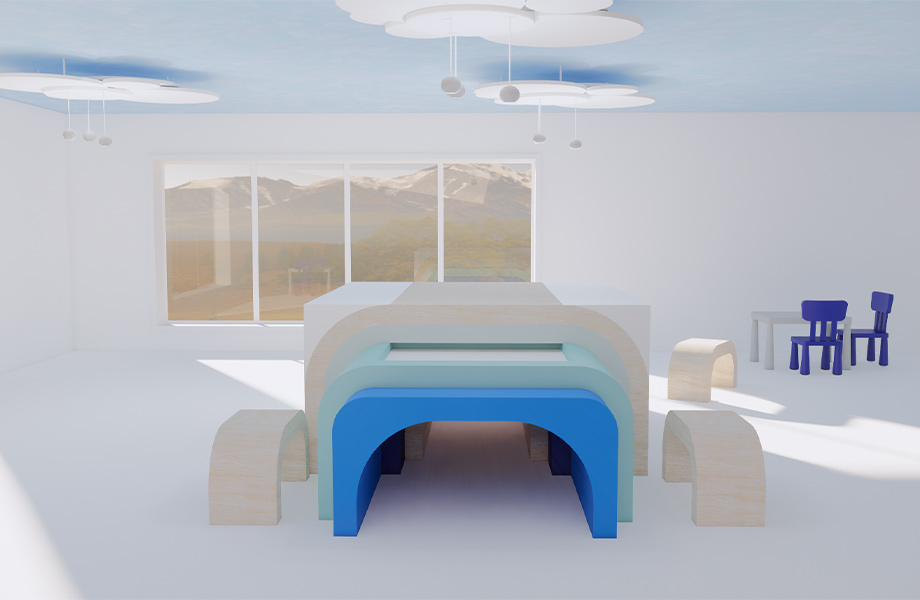
Creating VIVO took around 40 hours, spread across several key stages. Kassandra began by researching existing school furniture to identify useful elements, then sketched her ideas freehand before modelling them in 3D with SketchUp. The most demanding phase was the technical design, where she had to work out the joints, stability, and how the furniture would be used, in precise detail. Finally, she explored around thirty colour combinations across Formica® laminates and FENIX® surfaces before landing on her final palette.
For the project, she favoured Formica® laminates for their easy maintenance and their ability to be made magnetic and writable — features particularly well suited to a school setting. The palette, built mainly on whites and blues, creates a bright, calming environment that invites joy.
Recognition that matters
Winning the competition came as a complete surprise to Kassandra — and a source of real pride. “I knew there were a lot of entrants and that the level was high, so I really didn’t expect to win. I’m very proud of my project, where every detail was carefully considered and optimized, and the fact that the judges appreciated and recognized the quality of my work is extremely rewarding,” says Kassandra Avila.
Passionate about her field, Kassandra plans to keep deepening her knowledge of construction, and of residential design in particular, to maintain a balance between creativity and technical expertise.
Her advice to anyone considering entering a future edition of the competition is unequivocal: “Trust yourselves and submit a project that genuinely reflects your craft. A well-considered, aesthetically strong project, aligned with your own vision, is the key to standing out — and, above all, to being proud of what you’ve made!”
Émile Tessier

At just 20, Émile Tessier is already making his mark with a sensitive, thoughtful approach to interior design. A student at Cégep Saint-Jean-sur-Richelieu and originally from Granby, he is part of a new generation of designers driven by a desire to explore, understand and create differently. His path reflects a growing curiosity about built environments and the materials that shape them.
His first encounter with interior design came when his parents undertook major renovations at home. Drawn to the field, Émile decided, on leaving high school, to enrol in the interior design program. He wanted to study in a discipline that would let him put his creativity to use. He quickly found his calling, and his way of seeing the world around him shifted: he now observes spaces, analyzes material choices, and is gradually developing a sensibility for the details that shape daily life.
With his project The Foam, Émile tied for second place in the 2026 FORM Student Innovation Competition.
The Foam: turning the everyday into playful experience
The Foam (or La Mousse, in French) draws its inspiration from an everyday element that is at once simple and poetic. For Émile, foam — like joy — is light, luminous and fleeting, a reminder that joy can emerge from the most ordinary things when we know how to pay attention.
This idea takes form in a piece of furniture that is playful, functional and adaptable, designed for spaces frequented by children, such as daycares and elementary schools. The unit includes a table and stools that can be set out for specific activities, then easily stowed to free up space.
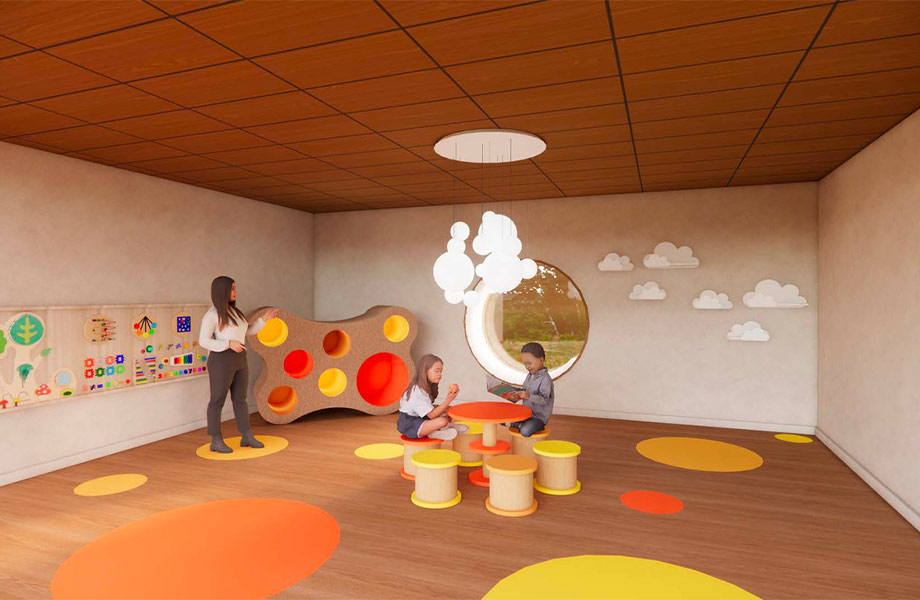
The choice of materials and finishes follows the same logic. The tabletop is made from Formica® brand writable surfaces, allowing children to draw directly on them without restriction, while the matte finish is used for the benches and storage areas. The aim is a piece that is durable, practical and stimulating all at once.
Yellow and orange laminates were chosen for their association with joy, energy and creativity, and are combined harmoniously. Émile also chose to incorporate a magnetic laminate that allows scraps of coloured material to be reused, turned into interactive elements for children. The approach helps reduce waste while enriching the playful experience of the piece — an aspect that matters deeply to the young designer.
A source of motivation
Having entered the competition as part of an academic project, Émile quickly saw it as a chance to push himself and step outside the usual framework of school assessments. “I’m very proud to have taken second place in the competition. For me, it’s tangible recognition of the effort I put into my project, and a source of motivation to keep developing professionally,” says Émile Tessier. Grateful for the experience, he encourages other students to seize these kinds of opportunities, and to keep learning and pushing themselves.
As he nears the end of his CEGEP studies, the future looks bright for the young designer. Émile is looking ahead with an open mind, eager to enter the workforce and practise the craft he is passionate about.
Maryssa Baril

At 26, Maryssa Baril is completing her final semester in interior design at Dawson College, wrapping up a three-year program. She grew up in a creative household — her mother drawn to painting, her father always at work on some renovation project around the house — and developed an interest in design and the built environment early on.
On leaving high school, Maryssa first enrolled in languages at CEGEP. After some reflection, she changed course and chose interior design instead — a decision that became a turning point. She found a discipline that brings creativity and technical thinking together, a balance that matches the way she sees things.
VeloVibe: rethinking storage
VeloVibe, the project that earned Maryssa her honourable mention in the 2026 FORM Student Innovation Competition, was prompted by a very Montreal problem: the shortage of storage space in apartments across the city and other urban centres. Her concept offers a dedicated, functional and aesthetically considered place for bicycles — keeping them off balconies, out of hallways, and away from the places they don't really belong.
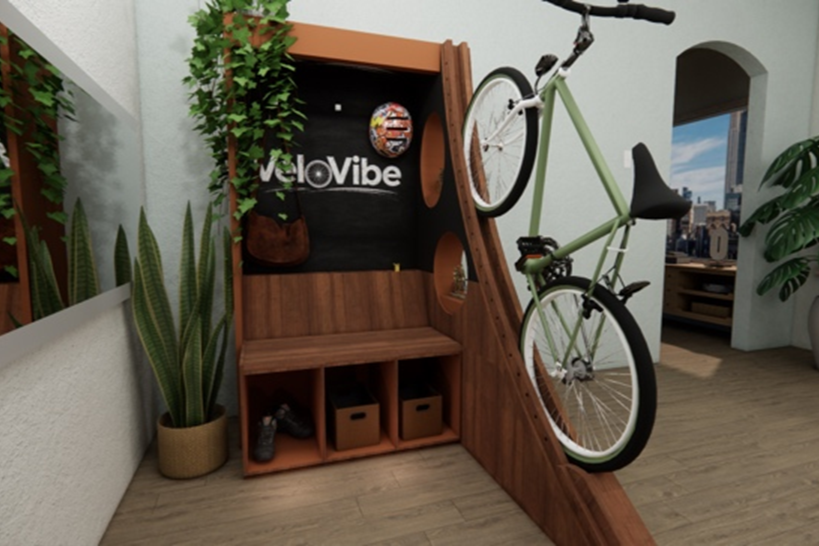
Developed over the course of a month as part of a furniture and construction class, VeloVibe grew out of exploring three initial concepts. Maryssa selected the strongest of the three and refined the design with a focus on ergonomics, functionality and user experience, then produced the detailed technical drawings needed to bring it to life.
The project also stands out for its approach to materials. It incorporates a range of Formica® brand laminate designs, along with interactive surfaces including a black magnetic chalkboard and a writable surface with a glossy finish, also available in the Formica® brand product line. Recycled materials were worked into certain details as well, notably the hooks.
"I'm very proud to have received this honourable mention — it validates my approach, both creatively and technically. With VeloVibe, I wanted to offer a concrete, functional solution tailored to urban realities. This recognition encourages me to keep designing projects that bring together aesthetics, utility and user experience, and to continue growing in the field of interior design," says Maryssa Baril.
Maryssa will complete her program in May 2026 and present VeloVibe alongside other works she is particularly proud of at Dawson College's interior design exhibition — a carbon-neutral, zero-waste event scheduled for late May 2026.
A look back at inspiring talent
We are incredibly proud of this year’s Canadian winners and the fresh perspectives they bring to the future of design. Their work reminds us of the powerful role design can play in shaping how we feel and experience the world around us.
You can also revisit last year’s projects and view the profiles of the 2025 Canadian winners.